Edition II - SemDH2025
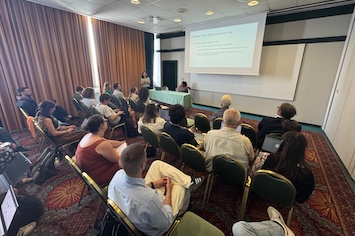
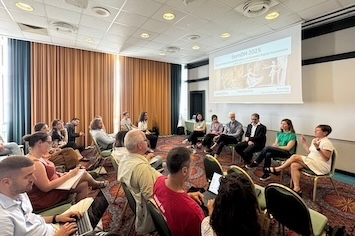
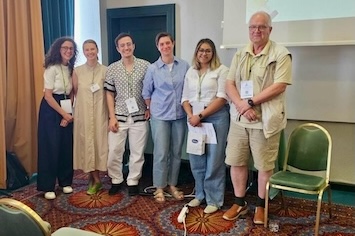
The Second International Workshop of Semantic Digital Humanities was held in Portoroz, Slovenia on June 02, 2025 and was co-located with the 22nd Extended Semantic Web Conference.

Proceedings
O. Bruns, A. Graciotti, B. Sartini, and T. Tietz (Eds): Proceedings of the Second International Workshop of Semantic Digital Humanities (SemDH 2025) co-located with ESWC 2025. CEUR workshop proceedings, vol. 4009, 2025
Go to ProceedingsProgram
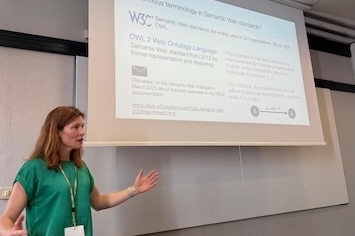
SemDH2025 presented a variety of novel works that explored how Linked Open Data (LOD) addresses the challenges of representing, preserving, and enhancing cultural knowledge. Out of the 20 papers submitted for peer-review to this workshop, 12 papers were accepted for this volume, 3 as full research papers, and 9 as short or position papers. The topics of the papers covered a range of research problems, including the development of CH knowledge graphs, visualization tools for historical data, and the application of semantic technologies to literary tourism, coreference resolution for ancient languages, the creation of digital humanities research portals, etc. The technical possibilities of the Semantic Web were explored, but the discussions also touched on the need for humanistic perspectives to guide the development of systems that truly serve the needs of the DH and CH communities. Thus, a central common theme mentioned across the papers was the importance of interdisciplinary collaboration between the Semantic Web, Cultural Heritage, and Digital Humanities fields. A major topic of discussion was the growing recognition of cultural bias in LOD. The papers, the keynote, and the panel discussion highlighted the need to confront biases within CH collections and historical datasets. As cultural knowledge is encoded into digital systems, outdated and offensive terminology, as well as stereotypical representations, can be perpetuated inadvertently. The keynote by Laura Hollink addressed these issues, analyzing the presence of such bias across structured metadata, controlled vocabularies, and knowledge graphs. The panel discussion further emphasized the critical role of addressing cultural bias within LOD, discussing practical strategies for detection and mitigation. As the workshop progressed, these discussions set the stage for continued reflection and action toward creating inclusive, fair, and culturally responsible LOD systems.
SemDH2025 program SemDH 2025 keynote and panelBest Paper Award
Taking into consideration both the initial reviews, the presentations and resulting discussions, the SemDH organizing committee decided to give the best paper award to Enhancing Provenance Research with Linked Data: A Visual Approach to Knowledge Discovery by Sarah Binta Alam Shoilee et al.
Travel Grant
We were able to award travel grants to two student authors, providing €1,000 each. This support enabled them to attend SemDH and ESWC in person in Portorož. This was made possible by our sponsor NFDI4Culture, the German National Consortium for Research Data on Material and Immaterial Cultural Heritage.
Organizing Committee
- Sasha Bruns, FIZ Karlsruhe and Karlsruhe Institute of Technology (Germany)
- Arianna Graciotti, University of Bologna (Italy)
- Bruno Sartini, Ludwig Maximilian University of Munich (Germany)
- Tabea Tietz, FIZ Karlsruhe and Karlsruhe Institute of Technology (Germany)
Steering Committee
- Catherine Faron, Université Côte d'Azur (France)
- Laura Hollink, Centrum Wiskunde Informatica (Netherlands)
- Eero Hyvonen, Aalto University (Finland)
- Mareike König, German Historical Institute Paris (France)
- Valentina Presutti, University of Bologna (Italy)
- Harald Sack, FIZ Karlsruhe (Germany)
- Stefan Schlobach, Vrije Universiteit Amsterdam (Netherlands)
- Torsten Schrade, Academy of Sciences and Literature Mainz (Germany)
- Francesca Tomasi, University of Bologna (Italy)
Program Committee
- Sarah Binta Alam Shoilee, Vrije Universiteit Amsterdam
- Sofia Baroncini, Leibniz Institut für Europäische Geschichte (IEG)
- Victor de Boer, Vrije Universiteit Amsterdam
- Oleksandra Bruns, FIZ Karlsruhe
- Catherine Faron, Université Côte d'Azur
- Arianna Graciotti, University of Bologna
- Ivan Heibi, University of Bologna
- Shufan Jiang, FIZ Karlsruhe
- Nitisha Jain, King's College London, London, United Kingdom
- Mary Ann Tan, FIZ Karlsruhe
- Tabea Tietz, FIZ Karlsruhe
- Francesca Tomasi, University of Bologna
- Jacco van Ossenbruggen, VU Amsterdam
- Delfina Sol Martinez Pandiani, University of Amsterdam
- Mareike Koenig, Deutsches Historisches Institut Paris
- Nicolas Lazzari, University of Bologna
- Fabio Mariani, University of Augsburg
- Bruno Sartini, Ludwig Maximilians Universität München
- Harald Sack, FIZ Karlsruhe, Leibniz Institute for Information Infrastructure & KIT Karlsruhe
- Gunjan Singh, FIZ Karlsruhe
- Gianmarco Spinaci, Villa i tatti, Harvard University
- Stefano De Giorgis, University of Bologna
- Shenghui Wang, University of Twente
- Mathias Zinnen, Friedrich Alexander Universität Erlangen Nürnberg